
You might be shocked to know that 80% of press releases do not even make it past the subject line when asked by various journalists. Because the foundation of the press release is not backed up by a subject line. With hundreds of emails lying in the inbox, it’s very hard for journalists to sort what should get published and what has to be deleted.
A press release is an official announcement distributed to journalists and media contacts, structured so that reporters can quickly turn it into published coverage. So make sure that it includes every detail, facts and data. In this blog, we will read about the press releases that journalists can’t ignore, and what mistakes you have to avoid while writing the press release.
What Is a Press Release and When Should You Write One?
A press release is a 400–600-word news document written in journalistic style, distributed to media contacts for media outreach to announce something newsworthy on behalf of a brand or organisation.
Write one when you have:
- A product launch or major feature update
- A funding round or investment announcement
- A new partnership or acquisition
- An award, ranking, or industry recognition
- A leadership appointment or executive change
- A major event, study, or research publication
Do not write one for:
- A minor website update or rebrand
- A sale, discount, or promotional offer
- An internal process change with no public relevance
- Anything that only your team finds interesting
According to Cision’s 2026 State of the Media Report, 97% of journalists use social media for a variety of work-related purposes, from promoting stories to interacting with their audiences. Journalists also claim that most of the news is not newsworthy. If you cannot explain why the public should care in one sentence, you are not ready to write the release.
6 Elements Every Release Must Have
Element | Purpose | Length |
|---|---|---|
Headline | Grabs attention, delivers the news | 1-2 lines, under 120 characters |
Dateline | Location and date of the announcement | 1 line |
Lead paragraph | Answers who, what, when, where, and why | 2–3 sentences |
Body copy | Supporting detail, context, validation | 2–3 paragraphs |
Quote | Human perspective from a spokesperson | 2–3 sentences |
Boilerplate | About the company | 5 sentences max |
Every element is important for writing a press release. Even if any one of the press releases is removed or ignored, it becomes hard for a journalist to use that news. Whereas it becomes easier to ignore.
How to Write a Headline Journalists Cannot Ignore?
A headline is the most important part of any writing, as it summarises everything you are going to read below. A headline gives you an idea whether you want to read below or not, so it has to be catchy and unique to the journalist to make him pause.
Follow these three simple steps to get the attention of the journalists.
- Start with the news: Do not start with your company name, as it is less interesting for the journalist; instead, start with the actual news, any new tech innovation/ product launch, etc.
- Use numbers: figures and stats make your headline strong support and make it believable and easy to read. Avoid generic phrases like “significant growth” or “multiple” words.
- Add Subhead: Subheads enhance your headline and news. Most of the media platforms allow you to write subheadings and share extra details, important facts or percentages that did not go with the title. So it is important to use them smartly.
Weak Headline | Strong Headline |
ABC Ltd Announces New Partnership | ABC Ltd Partners with HDFC Bank to Offer Instant MSME Loans Up to ₹50 Lakh |
Company Launches New Product | SaaS Platform Reduces Customer Onboarding Time by 70% After New Automation Update |
Startup Raises Funding | EdTech Startup Raises ₹80 Crore Series A to Expand into Tier 2 Cities Across India |
The Lead Paragraph — Your Most Important Sentence
As you have already read about the importance of the headline, now you will read why the lead paragraph is equally important.
The headline is just the door to your main room; if someone opens that door, it’s important not to return them disappointed. The core of the lead paragraph is answering the 5Ws (why, when, who, what and where). This helps journalists to understand the storyline just by reading the headline and the lead paragraph.
This 5Ws format is called the inverted pyramid structure. The most important news is covered at the top of the pyramid and followed by secondary and additional details.
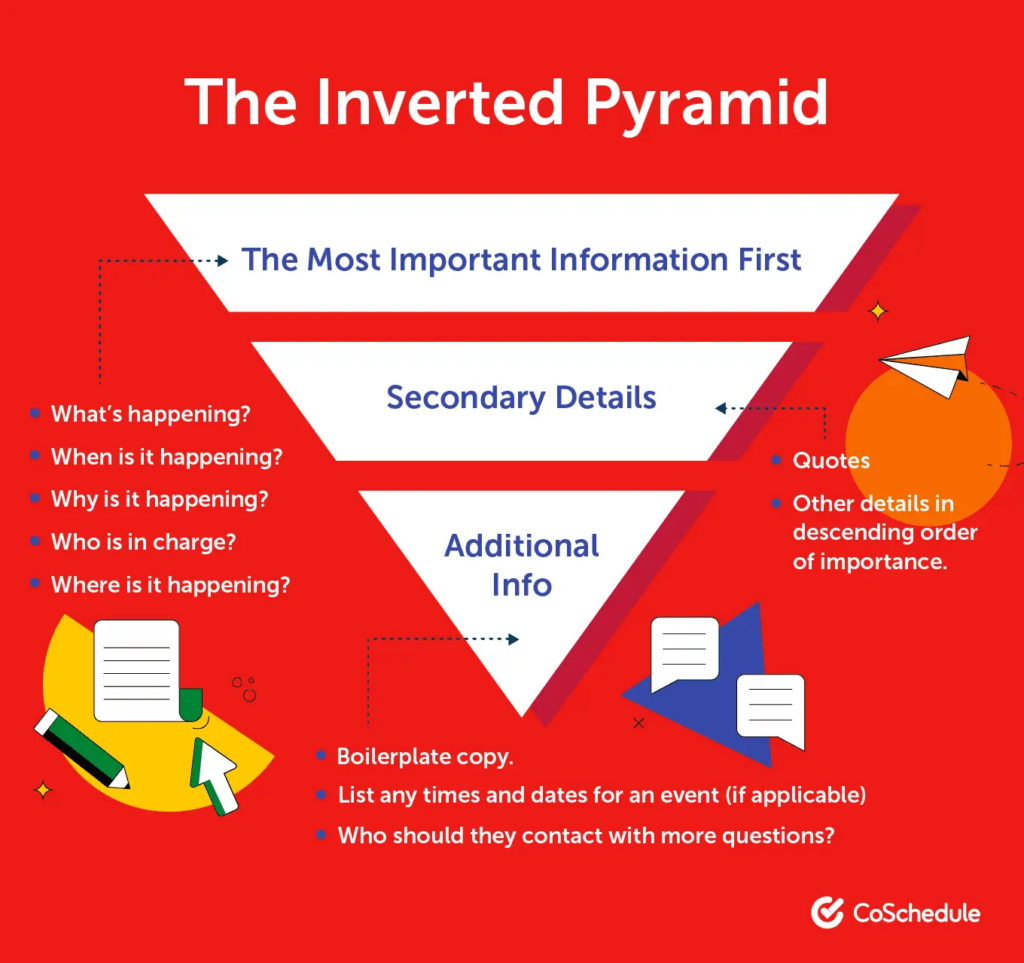
A common mistake is burying the actual news in the final paragraph, forcing journalists to read everything before reaching the point by which time they have already moved on. This is one of the leading reasons press releases get discarded.
It is very important for press releases to choose the words they are using, like (“industry-leading,” “revolutionary,” “best-in-class”). These are all generic words and get rejected by journalists, and even AI engines do not prioritise them. Add verifiable facts, stats, and data to make it valid and research-oriented.
Quotes That Add Value vs Quotes That Get Rewritten
According to Muck Rack’s 2026 journalist survey, 88% of journalists delete press releases that are not up to their standard. This means almost 9/10 of the press releases a journalist receives are rejected.
A strong quote includes what the human thinks, strategic reasoning, or the emotional context that can be used by the journalist directly in their content.
Try to write your quote like a real executive is speaking. Your quote should be direct, free of corporate language and specific to the facts.
Press Release Format in 2026 — What Has Changed?
Many studies related to press release format have analysed that now press releases are moving away from traditional storytelling and are moving towards a modern, straight, high-utility structure. This helps journalists to scan the press release without reading from top to bottom.
But there are a few things that most of the brands are still missing–the AI indexing. Now your articles/ press releases can be cited on the search engine. This helps in reaching more people, as nowadays people are searching with AI.
What this actually means:
- Write valid facts that are cited, not what the brand claims
- Do not use passive voice or superlative sentences
- To make it more valid, back them with stats, facts, and data
- When you post it on your company newsroom, add schema markup
- Whenever you use any media distribution service or PR wire, make sure that the links mentioned are cited directly to your own website for better SEO reach.
How to Distribute Your Press Release?
Once your press release is written and approved, distribution is where most brands either build or break their reach. There are two primary approaches: press release distribution services and direct journalist pitching, and the best strategies use both.
Method | Best For | Cost |
Direct journalist pitching | Targeted coverage, relationship building | Free |
Company newsroom (with schema) | AI indexing, long-term discoverability | Free |
Social media (LinkedIn, X) | Amplification after initial coverage | Free |
Press Wire / Distribution Services | Wide reach, SEO indexing, investor visibility, Syndication across news outlets and financial platforms | Paid |
Press release distribution services like PR Newswire and GlobeNewswire syndicate your release to thousands of newsrooms, financial databases and online platforms, simultaneously making them ideal for funding announcements, product launches, and anything that benefits from wide reach.
A PR wire service adds an additional layer of syndication, pushing your release directly into the editorial feeds of major publications and investor platforms.
That said, direct pitching to journalists remains the most effective method for earning meaningful editorial coverage. Send a personalised email to one journalist at a time, referencing their recent work and explaining exactly why your press release fits their beat.
Never send bulk pitches. Journalists can spot them immediately and they signal that you have not done your homework.
The smart approach combines both: use a PR wire or press release distribution service for broad reach and SEO discoverability, and reserve your personal outreach for the five to ten journalists who are the closest editorial fit for your story.
Mistakes to Avoid While Writing a Press Release
As you have already read, the format you have to use while writing a press release. Now let’s look at the table below and learn the mistakes that we have to avoid while writing the press release.
Mistakes | Why It Kills Your Coverage |
Writing it like a sales brochure | Journalists are not your customers; they are your publishers |
Hiding the news in paragraph 3 | Journalists stop reading before they reach it |
Corporate jargon in quotes | Most reporters rewrite or delete quotes that sound too corporate |
Sending to irrelevant journalists | Damages your credibility with that contact permanently |
Going over 600 words | Every extra word signals that the interesting part is hidden |
In 2026, the stakes are higher than they have ever been because the press release you write today is also the asset that AI search engines will index and cite for the next 18 months. Every word you write is either a citable fact or wasted space.
Frequently Asked Questions:
Does a press release help in SEO, even when no journalist covers it?
Yes, it can be useful in SEO because search engines will index the information and, thereby, increase the online presence of your company as well as the links to your website.
What is a media kit, and how is it different from a press release?
Press releases inform about the news, whereas media kits contain background information such as pictures, biographies, and statistics that journalists can use at any time.
How can I measure the effectiveness of my press release?
It will depend on whether there is an increase in website traffic, media coverage, social media activity, and inquiries following the press release.
What are free PR Wire websites?
Free PR Wire websites allow you to post your announcements, news and product launches free of cost on a PR wire website. Some free PR websites are PR.com, PRLog, OpenPR, 24-7 Press Releases and many more.
Where can I find journalists to pitch my stories?
You can find and pitch journalists by researching targeted media outlets directly, using journalist directories like Muck Rack, or joining sourcing platforms like Qwoted or Help a Reporter Out (HARO).